
ENERGY STAR at the Crossroads: What the MOA Means for the Future of the Program
Let's Save Energy
Alliance to Save Energy's Blog
On March 3, the U.S. Department of Energy (DOE) indicated its intent to assume primary oversight of the ENERGY STAR program it administers through a Memorandum of Agreement with EPA. The new agreement supersedes the 2009 Memorandum of Understanding (MOU), which housed the program at EPA for more than a decade before this shift to DOE leadership.
Under the new agreement, DOE and EPA have 90 days to finalize a detailed transition plan covering the transfer of partnership agreements, trademarks, IT systems, and databases. Contracts for program implementation currently exist between private parties and EPA, not DOE.
Despite the administration’s attempts to eliminate federal funding for the ENERGY STAR Program, Congress signaled its support by providing $33 million in FY 2026 funding for EPA to administer ENERGY STAR, in accordance with statute:
Provided, That of amounts made available for Environmental Programs and Management, not less than $33,024,000 is to carry out the Energy Star Program pursuant to section 324(c) of the Energy Policy and Conservation Act (42 U.S.C. 6294a(c))[1]
While it is unclear whether the FY26 EPA funding can transfer to DOE, ASE will work with the agencies and Congress to ensure the transition period includes stakeholder input and the resulting plan addresses long‑term staffing, adequate resourcing, and fulfillment of statutory obligations, particularly given recent staff reductions at both agencies.
Background and Benefits
The voluntary ENERGY STAR Program was founded in 1992 as a response to the Congressional desire to reduce air pollution through amendments to the landmark environmental legislation, the Clean Air Act.
The voluntary nature of the public-private partnership is one of its most defining and appealing characteristics. More than 15,000 Partners help the program achieve benefits that far outweigh its meager operating cost. Every federal dollar spent by EPA on ENERGY STAR has leveraged $230 from private-sector businesses and households.
The little blue star consistently punches above its weight. Nearly 90 percent of households recognize the blue ENERGY STAR label which accounts for more than $100 billion in annual product sales. Despite operating on a shoestring budget of roughly $30 million, the program consistently saves American households and businesses $40 billion each year on energy and water utility bills.
Recognizing the early successes of the program, Congress later codified the ENERGY STAR Program in the Energy Policy Act of 2005, assigning both DOE and EPA to administer it while leaving the structure and division of responsibilities for the agencies to determine.
Responsibilities under the program shall be divided between the Department of Energy and the Environmental Protection Agency in accordance with the terms of applicable agreements between those agencies. (42 U.S.C. 6294a (b))
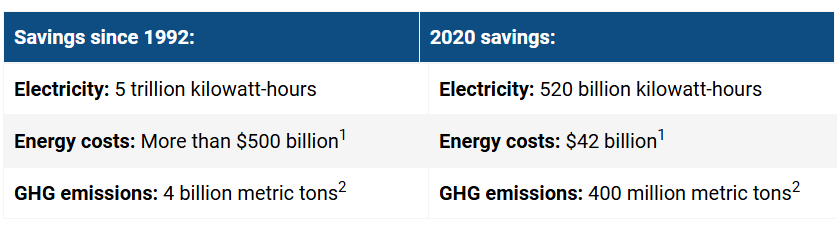
For roughly 32 years, EPA led the program and established a track record of success. Had program funding kept pace with inflation, annual funding would be nearly tripled at $85 million. (Benefits table follows)
(Source: ENERGY STAR)
Beyond Appliances: Portfolio Manager and Certified Buildings
ENERGY STAR Portfolio Manager has become a foundational tool for commercial real estate, providing owners and managers clear, actionable, unbiased insight into how their buildings use energy and how they compare to similar properties nationwide.
Nearly 25 percent of all U.S. commercial building space already benchmarks in the tool, reflecting its status as the industry standard for understanding building performance. Portfolio Manager helps identify underperforming properties, prioritize capital upgrades, and quantify cost‑saving opportunities. These capabilities translate directly into lower operating expenses, stronger asset performance, and improved competitiveness in leasing and investment markets.
ENERGY STAR-certified buildings, including homes, use 35 percent less energy, cost less to operate, and have higher rental and occupancy rates than their peers. A certified home means lower cost of ownership and can even earn better loan terms, resulting in fewer defaults.
What’s Next?
ASE is working with Congress and the agencies to identify stakeholder concerns, including the importance of a well-defined, transparent, and well-resourced transition plan. We encourage DOE to outline clear roles and responsibilities for each agency, how resources will be shared between agencies, and long-term workforce planning.
While the shift creates uncertainty, it is clear that ENERGY STAR’s credibility and success can continue, so long as the transition stays transparent, well-funded, and grounded in the program’s proven foundations.
ASE will continue working closely with DOE, EPA, and Congress to help ensure a stable, thoughtful path forward.
[1] See 42 U.S.C. 6294a (c), edited here for brevity: (c) DUTIES.—The (EPA) Administrator and the Secretary (of Energy) shall—(1) promote Energy Star compliant technologies as the preferred technologies in the marketplace for—(A) achieving energy efficiency; and (B) reducing pollution; (2) work to enhance public awareness of the Energy Star label, including by providing special outreach to small businesses; (3) preserve the integrity of the Energy Star label; (4) regularly update Energy Star product criteria for product categories….”
RECENT BLOG POSTS



STAY EMPOWERED
Help the Alliance advocate for policies to use energy more efficiently – supporting job creation, reduced emissions, and lower costs. Contact your member of Congress.
Energy efficiency is smart, nonpartisan, and practical. So are we. Our strength comes from an unparalleled group of Alliance Associates working collaboratively under the Alliance umbrella to pave the way for energy efficiency gains.
The power of efficiency is in your hands. Supporting the Alliance means supporting a vision for using energy more productively to achieve economic growth, a cleaner environment, and greater energy security, affordability, and reliability.